
don’t kill US twice: An Active Form of Memorialization – SİNEMA TRANSTOPIA – OkiNoWar week opening
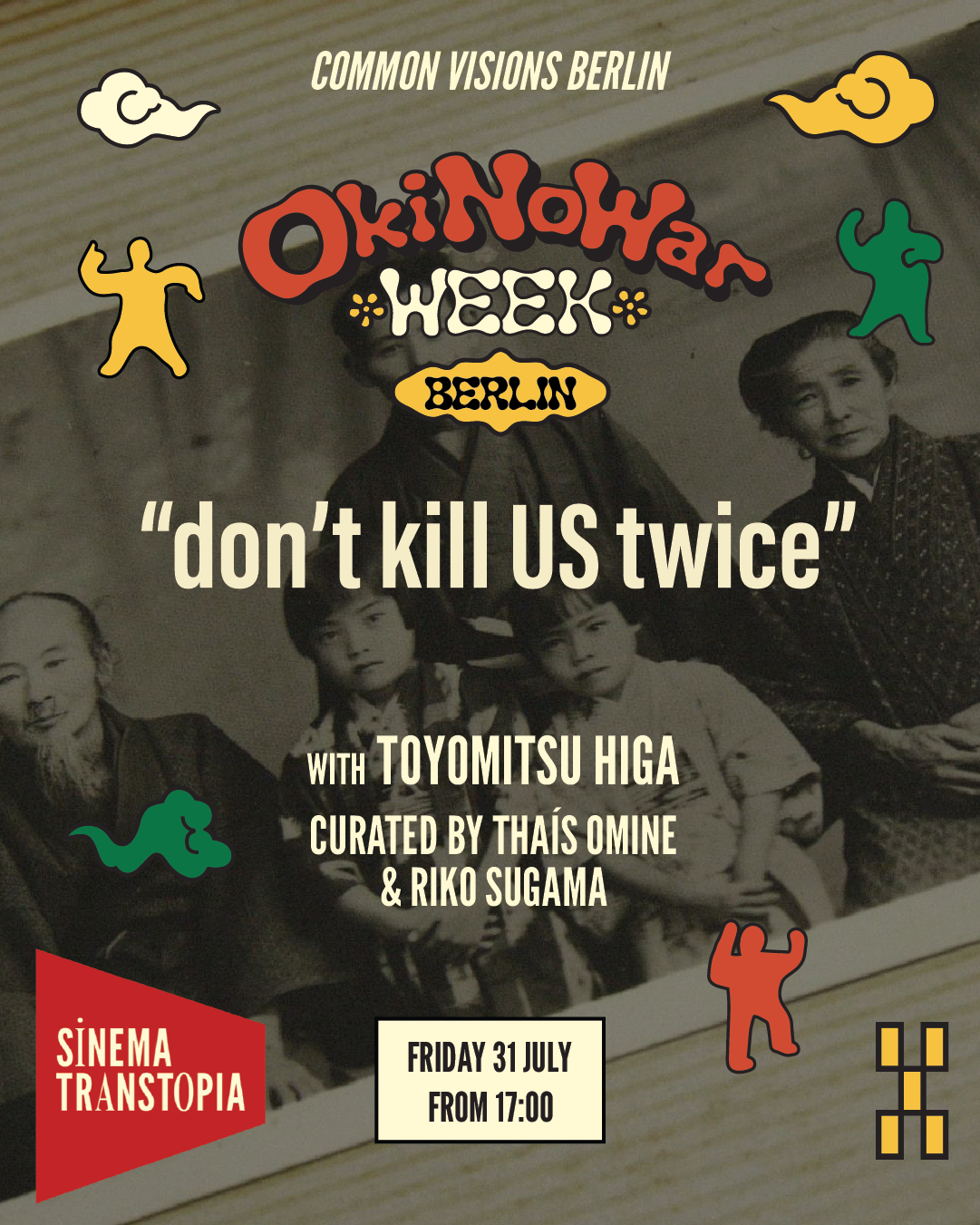
Curated by Thaís Omine & Riko Sugama
As part of OkiNoWar series, in dialogue with “NUCHI-GAFŪ du SHIDI-GAFŪ: Okinawa, the Art of Non-violence” at HKW and “Planetary Yui” at SAVVY Contemporary
The Ryukyus were not merely colonized. They were dismantled—systematically, ideologically, brutally. After Japan’s forcible annexation in 1879, the archipelago was subjected to decades of colonial assimilation. In the 1945 Battle of Okinawa, that subjugation became a death sentence: over 120,000 Okinawans died as a human bulwark for Japan. That was the first killing. Today, over twenty percent of Okinawa remains occupied by U.S. military installations, while the remains of thousands killed during the war continue to shape struggles over land, memory, and militarization.
This event brings together film screenings, conversation, and performance to reflect on Okinawa’s ongoing experience of war and occupation, and on memorialization as an active political practice. This is an active form of memorialization: not mourning alone, but refusal.
Thaís Omine is an Okinawan-Brazilian filmmaker and visual anthropologist based in Berlin. Working across film, research, curation, and dialogue-based formats, she explores migration, diaspora, silence, trauma, and unspoken memory.
Riko Sugama is a Berlin-based Ryukyuan dancer, singer, and sanshin performer from Okinawa, Japan. Born into a traditional Ryukyuan dance dojo and trained from early childhood, she developed a practice grounded in inherited tradition while continually exploring new creative possibilities.
TIMETABLE
17:00 Screening in cinema hall, walk-in anytime
ナナムイ (Nanamui Series)
Toyomitsu Higa, Japan, 1997–2001, 158 min. Miyako (Myākufutsu) with English subtitles
Nanamui (1997–2001) documents the sacred indigenous rituals of Miyako Island’s female priestesses, capturing spiritual songs and practices rarely shown to outsiders. Spiritual landscapes, indigenous memory, ritual spaces, and sacred relationships between people, land, and ancestors that create a dialogue between political resistance and spiritual continuity.
Toyomitsu Higa is one of the most influential photographers documenting Okinawan society and culture. Born in Yomitan, Okinawa, Japan, in 1950, he has devoted his practice to recording Okinawa’s rituals, landscapes, and everyday life, revealing the cultural and spiritual layers embedded in local communities.
The evening continues with Voices of the War Era in Shimakutuba. Toyomitsu Higa’s practice has traveled across the region: invited to the Gwangju Biennale (2014), he withdrew his work days after the opening to protest state censorship, in solidarity with a censored fellow artist. His work persistently articulates solidarity between Okinawa and Jeju Island—twin sites of civilian massacre and ongoing militarization. Higa also collaborated closely with bone-activist Takashi Gushiken, documenting his decades-long practice of returning war dead to families.
19:00 screening of 「しまくとぅばで語る戦世」(Voices of the War Era in Shimakutuba)
Toyomitsu Higa, Japan, 1997–2003, 65 min. Indigenous Ryukyuan Languages and Japanese with English subtitles
Followed by a talk with Toyomitsu Higa and Thaís Omine
21:00 Ryukyu dance & music live performance (Open Air)
The open air screening will begin with a traditional Okinawan music and dance performance by Riko Sugama, Victor Kinjo, Ayaka Nakazato, Rita Sugama, Takumi Hosokawa.
21:30 screening of Close To The Bone
Katsuya Okuma, Japan, France, 2024, 115 min. Japanese with English subtitles
Katsuya Okuma’s Close to the Bone follows Takashi Gushiken, an activist who has spent more than four decades recovering the remains of those killed during the Battle of Okinawa. As human remains continue to be unearthed from sites now threatened by military construction, the film asks what it means to mourn, remember, and refuse erasure.
ARTISTS:
Victor Kinjo is an Okinawan-Brazilian singer-songwriter and researcher based in São Paulo. He holds a PhD in Social Sciences from the University of Campinas, where he researched Japanese literature, Okinawan representation, (dis)identification, and performance.
Ayaka Nakazato is a Ryukyuan dancer from Ginowan, Okinawa, Japan. She began training in Ryukyuan dance at the age of six under Keiko Miyagi and later graduated from Okinawa Prefectural University of Arts, specializing in Ryukyuan performing arts.
Rita Sugama is a Ryukyuan dancer from Okinawa, Japan. She has studied Ryukyuan dance since 1994, developing a precise and refined performance style, particularly in onna-odori (female dance repertoire).
Takumi Hosokawa is a singer and sanshin musician from Naha, Okinawa, Japan. He began studying Ryukyuan classical music at the age of fourteen and later trained at Haebaru High School and Okinawa Prefectural University of Arts, specializing in Ryukyuan performance traditions.
Visit the OkiNoWar website for more information of the upcoming events!